Projected 2022 gross federal tax gap
The tax gap measures federal tax liabilities not paid voluntarily and on time. This figure is an IRS projection for Tax Year 2022.
Why PRISMA
Tax, payroll, classification, documentation, insurance, and corrective work often sit apart. PRISMA is a structured preventive operating model for that gap.
Common fragments
Governed sequence
Scale of the problem
Small businesses represent nearly half of the U.S. private workforce, yet many operate without structured compliance processes. PRISMA provides a repeatable framework that helps businesses organize responsibilities, reduce preventable risks, and build stronger operational practices.
Primary context
The tax gap measures federal tax liabilities not paid voluntarily and on time. This figure is an IRS projection for Tax Year 2022.
SBA Office of Advocacy reports 36,207,130 small businesses, about 99.9% of U.S. businesses (2026 FAQ).
SBA Office of Advocacy reports 62.3 million people employed by small businesses (2026 FAQ).
Additional context
IRS Tax Year 2022 projection for underreporting within the gross tax gap.
Approximately $80 billion in unpaid taxes annually attributed by the IRS to sole proprietors underreporting income, as reported by GAO. This does not imply that all sole proprietors are noncompliant.
SBA Office of Advocacy: small businesses employ 45.9% of private-sector workers (2026 FAQ).
SBA Office of Advocacy: small businesses account for 43.5% of GDP (2026 FAQ).
SBA Office of Advocacy: more than 80% of small-business federal paperwork burden comes from the IRS (2026 FAQ).
Operational fragmentation
Not every business faces every issue. The comparison shows common patterns and the intended PRISMA model.
Fragmented operations
Governed PRISMA system
Six-module architecture
Diagnosis precedes classification. Governance precedes implementation. Monitoring precedes transfer review.
Collect self-reported practice answers in plain language to surface provisional risks and opportunities.
T-01 intake
Organize findings with a common scoring approach and preliminary priority for professional review.
T-02 scoring, T-09 escalation
Make internal ownership, responsibilities, and reporting cadence visible without implying legal appointment.
T-10 governance and IGO competencies
Link controls across payroll, tax records, documentation, insurance, and related administration.
T-03–T-06 control instruments
Track findings, owners, dates, and corrective work so issues do not drift.
T-07 monitoring, T-08 corrective actions
Prepare a structured handoff toward internal autonomy, subject to professional determination.
T-10 transfer conditions, T-11 impact metrics
The sequence is fixed by design so findings, ownership, controls, and follow-through stay connected.
Reusable system
Twelve instruments support repeatable controls. The cases below are pedagogical illustrations, not client results.
Twelve T-series instruments
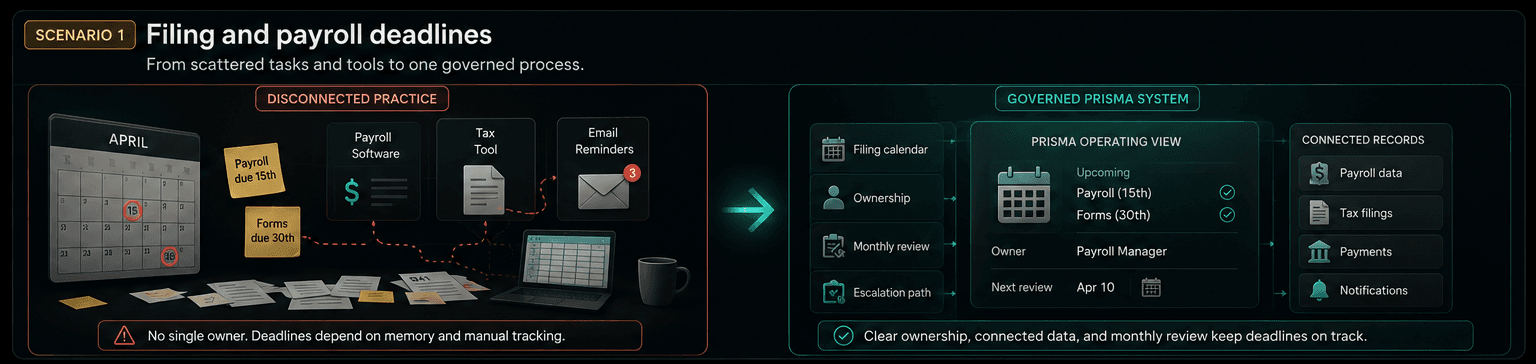
Swipe to inspect
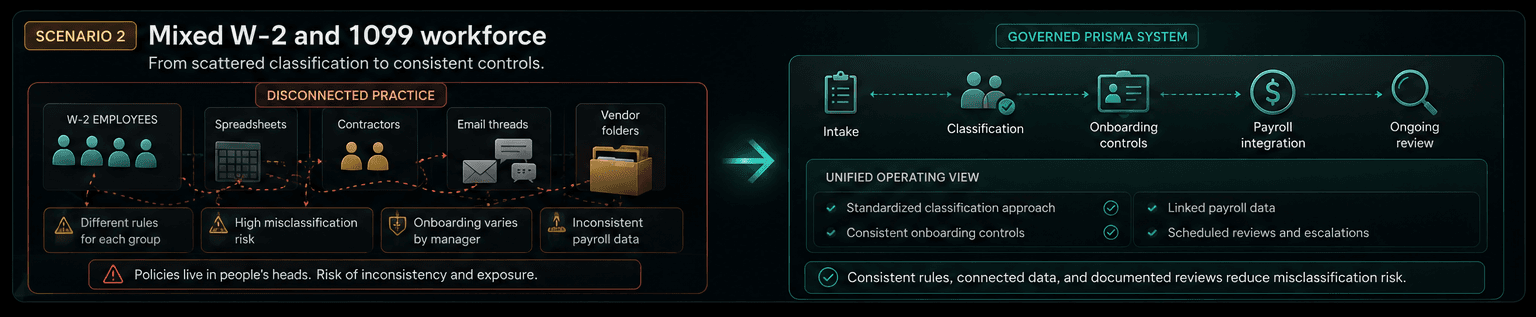
Swipe to inspect
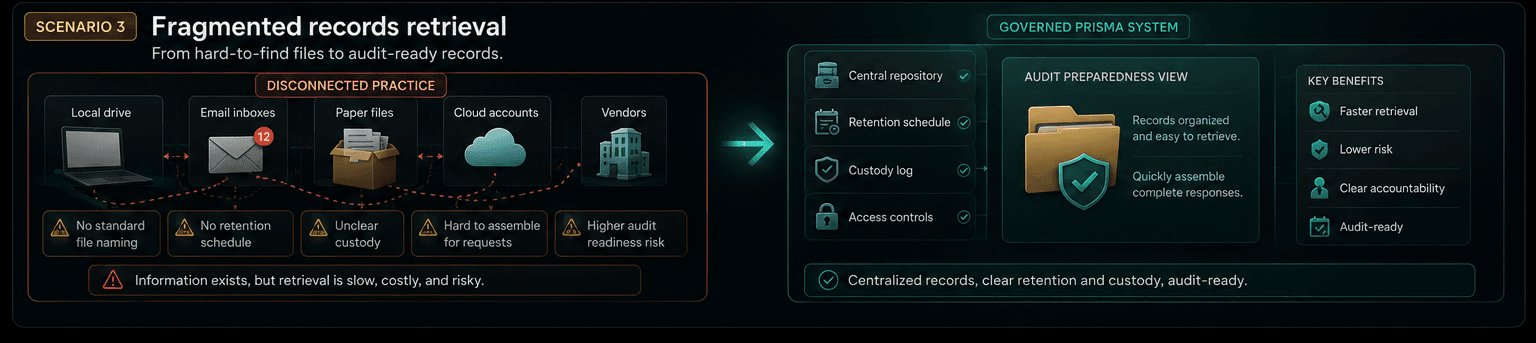
Swipe to inspect
These scenarios are teaching illustrations only. They are not customer stories, verified results, or adoption claims.
Planned measurement framework
T-11 definitions only. Designed for collection in live implementations. No verified public outcomes here.
Penalties and interest avoided
DefinitionDocumented penalty exposure identified at diagnostic, less penalties actually incurred.
Filing timeliness
DefinitionShare of required federal and state filings and deposits made by their due dates.
Worker-classification accuracy
DefinitionShare of workers whose W-2/1099 classification is documented as consistent with applicable tests.
Audit-readiness score
DefinitionComposite score of documentation completeness and retention against the audit checklist.
Jobs supported
DefinitionEmployees on payroll of served enterprises at implementation and at each annual review.
Autonomy attainment
DefinitionProfessional assessment of whether the enterprise meets transfer conditions for internal autonomy.
Illustrative structure only. No baselines, targets, or aggregate results are shown.
National relevance
Public evidence describes scale and pressure. PRISMA design and planned measurement stay labeled as such.
SBA Advocacy figures place tens of millions of small businesses and workers at national scale.
IRS tax-gap projections show unpaid federal liabilities at national scale.
W-2 and 1099 accuracy is a planned PRISMA measurement area, not a software legal determination.
Future AI-assisted workflows are planned with human-in-the-loop controls and intended NIST RMF alignment. No NIST endorsement is claimed.
Evidence boundaries
Public statistics, internal PRISMA design, and planned metrics stay separate from unverified outcomes.
Public evidence
PRISMA internal design
Sources
Government sources link to public URLs. The PRISMA endeavor document is an internal design source, not a public outcome report.
Internal Revenue Service
irs.gov · irs-the-tax-gap (Opens in a new tab)U.S. Government Accountability Office
gao.gov · gao-24-105281 (Opens in a new tab)U.S. Small Business Administration, Office of Advocacy
advocacy.sba.gov · frequently-asked-questions… (Opens in a new tab)PRISMA Framework
Internal framework source. No public URL.
Professional pathway
PRISMA’s planned dissemination pathway includes practitioner education, institutional collaboration, bilingual delivery, and standardized measurement.
Review product status for current boundaries, or start the free diagnostic for a provisional view from your own answers.